

For busy parents
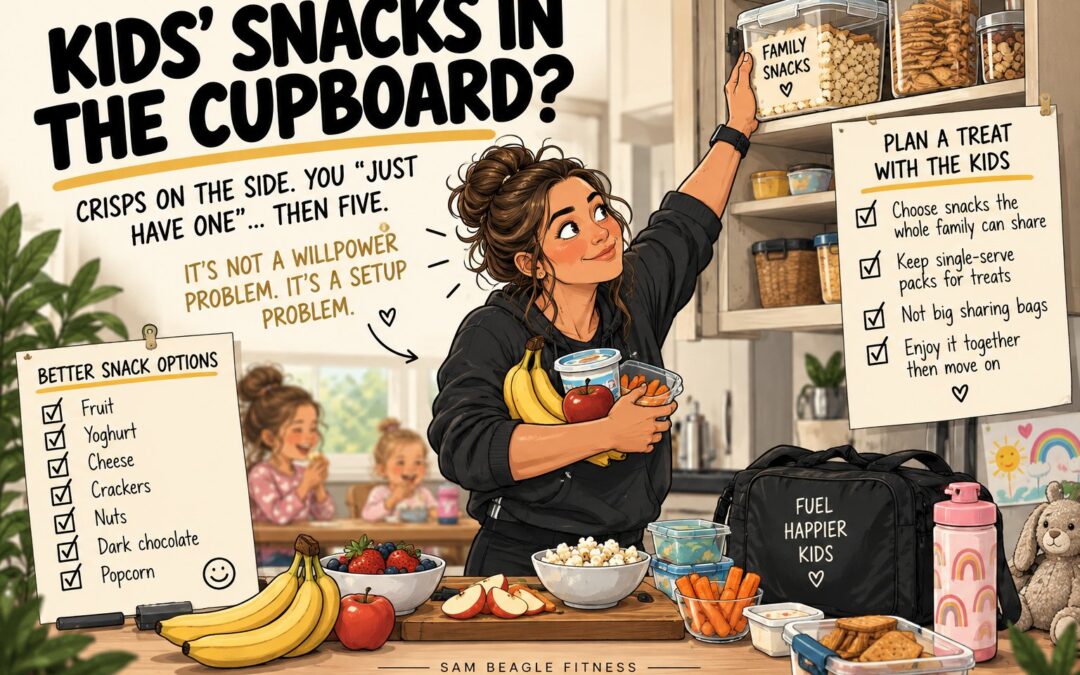
Kids' snacks in the cupboard?
Crisps on the side. You "just have one"... then five. It isn't a willpower problem. It's a setup problem, and once you understand the science behind it, it's much easier to fix.
I don't even want them. I eat them because they're there.
Almost every parent I coach says a version of this. The kids need snacks in the house, and those snacks are designed to be hard to leave alone. So you pick. A handful here, a biscuit there, the leftover fish fingers off the plate.
This guide explains why that happens, what's going on in your brain and body when you reach for the cupboard, and eight practical changes that make it far less likely. None of them involve banning anything.
Here's the map.
In this guide
- Environment beats willpower
- Why kids' snacks are so hard to resist
- 01 · Out of sight, out of mind
- 02 · Make the better choice easy
- 03 · Family snacks, not kids' snacks
- 04 · Eat proper meals first
- 05 · Plan your snack
- 06 · The 5-minute pause
- 07 · Stop being the family bin
- 08 · No forbidden foods
- Start small
The truth
Environment beats willpower
Willpower gets all the credit and all the blame, but research on eating behaviour points somewhere else. What you eat is heavily shaped by what's around you, how visible it is, and how much effort it takes to get to.
A large Cochrane review in 2019 pulled together the studies on food availability and proximity. The pattern was consistent. When less-healthy food is less available, or simply placed further away, people choose it less and eat less of it. They didn't try harder. The environment changed.
The science bit
Smaller experiments show the same thing at arm's length. In one study, people ate noticeably fewer sweets when the bowl sat just out of reach rather than right in front of them. Distance adds a moment of friction, and that friction gives the thinking part of your brain a chance to catch up with the impulse.
Every time you walk past an open packet of crisps, you make a decision. Make ten of those a day, every day, at the end of a long shift or after a broken night, and eventually one goes the other way. That's not a character flaw. It's maths.
You don't need more discipline. You need fewer decisions.
The science
Why kids' snacks are so hard to leave alone
They're engineered to be moreish
Many packaged snacks combine fat with sugar or salt in ratios you rarely find in whole foods. Researchers call these hyper-palatable foods. They hit the brain's reward system hard, and they're low in protein and fibre, the two things that tell you you've had enough. They're easy to start and hard to stop. In a tightly controlled NIH study, people offered ultra-processed food ate about 500 kcal a day more without meaning to. I cover that study in What to eat, and why it works.
Seeing food makes you want food
Just seeing or smelling tasty food can kick off what's called the cephalic phase response. Your body starts producing saliva and releasing insulin to get ready to eat, and a craving appears that wasn't there a minute ago. A packet on the worktop is a trigger you walk past twenty times a day.
Tired, stressed parents are primed to snack
This is the part nobody talks about. In a controlled sleep study, people limited to about five and a half hours in bed ate significantly more calories from snacks, even though their meals didn't change. Stress works in a similar way. People who release more cortisol under stress tend to eat more afterwards, and they reach for sweeter, higher-fat food. Put the two together and 3pm on a school day is a perfect storm.
None of this is weakness. It's your biology doing what it evolved to do. The good news is that your environment is something you control.
Tip 01
Out of sight, out of mind
This is the simplest change with the biggest impact. Make the kids' snacks less visible and slightly harder to reach, and most of those little decisions disappear.
A few extra seconds of effort sounds trivial. It isn't. That small bit of friction is exactly what the proximity research shows makes the difference.
Tip 02
Make the better choice the easy choice
Friction works both ways. Make the snack you want to eat quicker to grab than the one you don't. When you're hungry and rushed, you'll eat whatever takes the least effort.
Keep ready-to-eat options at eye level in the fridge:
Protein
Batch-cook six on Sunday. In their shells, they keep in the fridge for about a week.
Protein
Buy individual pots, or split a big tub into small jars.
Protein
Cook extra at dinner and keep a tub ready to go.
Protein
Individually wrapped, so the portion is decided for you.
Fruit & veg
Carrot and pepper sticks, grapes, melon. Chop once for the next few days.
Dips
Small pots next to the veg sticks turn them into a proper snack.
If it's quick to grab, you'll grab it. Aim for anything you can reach and eat within five seconds of opening the fridge.
Tip 03
Buy family snacks, not "kids' snacks"
If there are two tiers of food in the house, treats for the kids and healthy food for you, you've set up a daily tug of war. Choose snacks the whole family can share instead.
When treats are needed, go single-serve
Portion size has one of the strongest effects in nutrition research. A Cochrane review found that people consistently eat more when they're given bigger portions or bigger packages. It happens to everyone, whatever their size and however much they believe they're in control. A single-serve bag has a built-in stopping point. A sharing bag doesn't. It just has a bottom.
Tip 04
Eat proper meals first
Most afternoon grazing is really under-fuelling at lunch. If lunch was a sandwich eaten standing up, or nothing at all, of course the kids' crisps look appealing at 3pm. Your body is asking for energy, and it will take the fastest route it can find.
- Protein + veg or fruit
- at every meal
- 1 palm
- of protein per meal for most women, 2 for most men
- 1 fist
- of veg or fruit alongside it
The science bit
Protein is the most filling of the three macronutrients. It raises the fullness hormones GLP-1 and PYY and lowers ghrelin, the hormone that drives hunger. In one study of young women who normally skipped breakfast, a high-protein breakfast reduced their evening snacking on high-fat and high-sugar foods. The protein you eat earlier shapes the cravings you get later.
You'll be surprised how much the snack urges drop. For the full breakdown of portions and why they work, read What to eat, and why it works.
Tip 05
Plan your snack
Decide in advance, not when you're tired at 3pm. A planned snack is fuel. A random one is usually habit.
The formula is simple: protein plus fruit or veg. The protein keeps you full, and the fruit or veg adds fibre, water and volume for very few calories.
- Apple + cheese
- Crunch, sweetness and protein
- Yoghurt + berries
- Around 15g protein, plus fibre
- Houmous + carrots
- Fibre and healthy fats
- 2 eggs + cherry tomatoes
- About 12g protein
- Ham + cucumber
- Ready in 30 seconds
Pick two or three you actually like, and make sure they're in the fridge on Sunday night. That way "what shall I have?" is already answered before you're hungry.
Tip 06
The 5-minute pause
This one is for the moments when you find yourself in the cupboard without quite knowing how you got there.
Ask yourself
"Am I hungry, or is this habit, stress or boredom?"
A useful rule of thumb: physical hunger builds gradually and most foods would do. A craving arrives suddenly and wants one specific thing, usually something sweet or salty.
- 01Pause and ask the questionJust noticing the urge breaks the autopilot.
- 02Have a glass of waterIt gives your hands something to do, and it covers you if you're simply thirsty.
- 03Wait five minutesDo something else in the meantime. Cravings tend to rise and fall like a wave.
- 04Still want it? Have itPut it on a plate, sit down and enjoy it. No guilt.
Often, by the time five minutes are up, the urge has passed. When it hasn't, you're eating on purpose rather than on autopilot, which is a very different experience. You'll usually find that a smaller amount does the job.
Tip 07
Stop being the family bin
Picking doesn't feel like eating, and that's the problem. A couple of leftover fish fingers, a few crusts, the last of the pasta from the pan. None of it feels like a meal, so none of it feels like food, but your body counts every bite.
- 2 fish fingers
- ≈ 100 kcal
- Crusts and pasta scraps
- ≈ 100 kcal
- A handful of crisps
- ≈ 130 kcal
- A couple of biscuits
- ≈ 140 kcal
- ≈ 470 kcal
- close to an extra meal, every day
These are ballpark figures, but over a week that's more than 3,000 kcal you never really noticed eating. Here's how to stop it.
Picking adds up faster than you think.
Tip 08
No forbidden foods
This might sound backwards. Surely banning the biscuits is the answer? The research says otherwise.
Rigid rules backfire
Studies comparing "rigid" dieters, who follow strict all-or-nothing rules, with "flexible" dieters, who take a moderate and balanced approach, keep finding the same thing. The rigid group is more likely to overeat and less likely to keep weight off. One slip feels like failure, and failure feels like permission to finish the packet.
It works the same way for kids
In a classic study, restricting children's access to a tasty snack made them want it more, and they ate more of it once it was available. Food that's forbidden becomes special. Food that's normal becomes, well, normal.
So plan a treat with the kids a few times a week. Sit down, enjoy it together, then move on.
Food is fuel, with room for fun.
Making it stick
Start small
Don't try all of this at once. Pick one tip this week and nail it. When it feels automatic, add the next one. Here's an order that works well for most families:
- 01Week one: move the kids' snacksPut them in an opaque box, up high or at the back, and clear the worktop.
- 02Week two: stock the fridgeKeep two or three grab-in-five-seconds options at eye level.
- 03Week three: fix lunchProtein plus veg or fruit, sitting down.
- 04Week four: close the kitchenStop picking leftovers and set a cut-off after dinner.
Small wins, done consistently, build sustainable strength.
Sustainable beats perfect. Every time.
“It's not a willpower problem. It's a setup problem. Change the setup, and you won't need to rely on willpower.”
Want a setup that fits your family?
We'll look at your routine, your kitchen and your week, and build a plan around real family life rather than a perfect one. It happens 1:1 at our Northwood studio or online.
Start your Sustainable Strength coachingKey research referenced
- Hollands GJ et al. (2019). Altering the availability or proximity of food, alcohol, and tobacco products to change their selection and consumption. Cochrane Database of Systematic Reviews.
- Hollands GJ et al. (2015). Portion, package or tableware size for changing selection and consumption of food, alcohol and tobacco. Cochrane Database of Systematic Reviews.
- Maas J et al. (2012). Do distant foods decrease intake? The effect of food accessibility on consumption. Psychology & Health.
- Fazzino TL et al. (2019). Hyper-palatable foods: development of a quantitative definition and application to the US food system database. Obesity.
- Hall KD et al. (2019). Ultra-processed diets cause excess calorie intake and weight gain. Cell Metabolism.
- Nedeltcheva AV et al. (2009). Sleep curtailment is accompanied by increased intake of calories from snacks. American Journal of Clinical Nutrition.
- Epel E et al. (2001). Stress may add bite to appetite in women: a laboratory study of stress-induced cortisol and eating behavior. Psychoneuroendocrinology.
- Leidy HJ et al. (2013). Beneficial effects of a higher-protein breakfast on the appetitive, hormonal, and neural signals controlling energy intake regulation in overweight/obese, breakfast-skipping, late-adolescent girls. American Journal of Clinical Nutrition.
- Westenhoefer J, Stunkard AJ, Pudel V (1999). Validation of the flexible and rigid control dimensions of dietary restraint. International Journal of Eating Disorders.
- Fisher JO, Birch LL (1999). Restricting access to palatable foods affects children's behavioral response, food selection, and intake. American Journal of Clinical Nutrition.
- NHS. Food allergies in babies and young children: nuts.