

Strength training
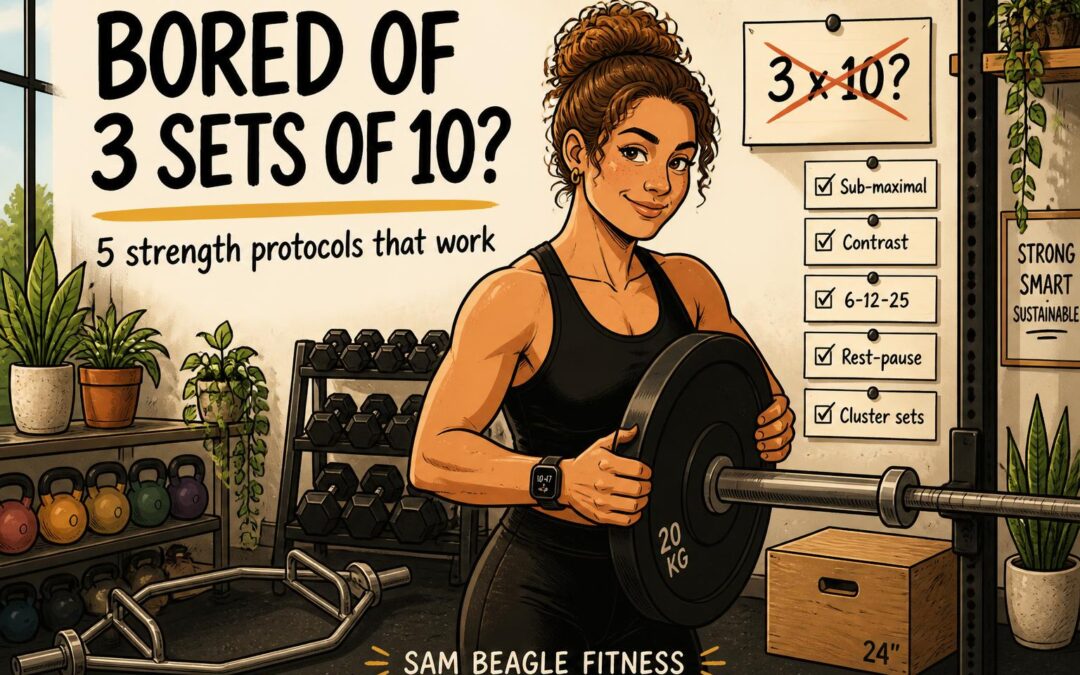
Bored of 3 sets of 10?
Five proven ways to build strength that aren't 3 sets of 10. What each one is, why it works, when to use it, and exactly how to do it.
I do the same sets and reps every week. I'm not getting any stronger.
3 sets of 10 isn't wrong. It's a solid, simple way to train, and it's probably built a lot of your strength so far. The problem is that doing the same thing for too long gives your body no new reason to adapt.
Strength comes from giving your muscles and nervous system a challenge they haven't fully adapted to yet, then recovering from it. You can change that challenge in a few ways: how heavy the weight is, how many reps you do, how much rest you take, and how hard you push each set. Every protocol in this guide changes one or more of those levers.
None of them are gimmicks. They're used in strength and conditioning every day, and each one has a specific job. Here's the map.
Before we start
Two terms you need first
Every protocol below is described using two simple ideas. Once you've got these, the rest makes sense.
- 1RM
- Your one-rep max: the most you can lift once with good form
- RIR
- Reps in reserve: how many more good reps you could have done
RIR is the one to learn. Finishing a set with "2 in reserve" means you stopped when you could have done 2 more clean reps. It's how we control effort without testing maxes, and research shows most people can judge it accurately with a bit of practice, especially close to failure.
The science bit
You don't need to go to failure to get stronger. A 2022 meta-analysis found that training to failure and stopping short of it produced similar strength gains. Grinding every set to failure mostly adds fatigue, which is the last thing a busy parent with broken sleep needs.
Protocol 1
Sub-maximal training
Heavy enough to count, never so heavy it's a fight.
What it is
You lift moderately heavy weights, usually around 70–85% of your max, for low reps, and you always finish with 2–3 reps in reserve. Instead of 3 hard sets of 10, you might do 5 crisp sets of 3. Every rep looks the same: fast, controlled and technically clean.
Why it works
Strength is partly a skill. Your nervous system learns to recruit more muscle fibres and coordinate them better every time you practise a heavy movement well. Sub-maximal training gives you lots of high-quality practice with meaningful loads, without the fatigue or injury risk of maximal efforts. You leave the gym feeling better than when you arrived, and you can recover in time for the next session.
When to use it
- Trap bar deadlift
- 5 × 3 at ~80%, 2–3 in reserve, rest 2 min
- Goblet or front squat
- 4 × 4, 2–3 in reserve, rest 90 sec
- Progress it
- Add a small amount of weight each week while the reps stay crisp
Coach's cue
If the last rep of a set slows right down or your form changes, it was too heavy. Sub-maximal only works if you respect the "in reserve" part.
Protocol 2
Contrast training
Lift heavy, then move fast.
What it is
You pair a heavy strength exercise with an explosive movement that uses a similar pattern. You do a few heavy reps, rest briefly, then perform a fast, powerful version of the movement, such as a jump or throw. That's one contrast pair.
Why it works
A heavy set can temporarily boost how much force your muscles produce in the minutes that follow. Researchers call this post-activation performance enhancement. You then use that boost to train power, the ability to produce force quickly. The effect is real but modest, it varies between people, and stronger, more experienced lifters tend to benefit most. Even without the boost, contrast training gets strength and speed work done in one efficient pairing.
Power matters more than most people realise. It drops faster than strength as we age, and it's what lets you catch yourself when you trip, sprint after a toddler, or play five-a-side without pulling something.
When to use it
- Trap bar deadlift → broad jump
- 3 heavy reps, rest 60–90 sec, 3 jumps. Rest 3 min. 3–4 rounds
- Front squat → box jump
- 3 heavy reps, rest 60–90 sec, 3 jumps onto a low box
- Bench press → med ball chest pass
- 3 heavy reps, rest 60–90 sec, 5 fast throws against a wall
Coach's cue
Every explosive rep should be your fastest. The moment they slow down, the set is over.
Protocol 3
6-12-25
Three rep ranges, one muscle group, one brutal round.
What it is
A giant set of three exercises for the same muscle group, done back to back with only about 10 seconds between them. First 6 heavy reps, then 12 moderate reps, then 25 light reps. Rest 2–3 minutes, then repeat for 2–3 rounds in total.
Why it works
Each part hits the muscle differently. The 6 reps use heavy load and high tension, the 12 reps build volume, and the 25 reps create a big "pump" and metabolic stress. Together they're a very effective way to build muscle in a short time, and more muscle is more potential strength. It's also a great test of mental toughness.
When to use it
Keep it to simpler, stable exercises such as dumbbells, machines, cables and bodyweight. It's not for technical barbell lifts, because form breaks down under this much fatigue.
- Upper back
- 6 chin-ups → 12 lat pulldowns → 25 band pulldowns
- Legs
- 6 heavy DB split squats (each leg) → 12 goblet squats → 25 bodyweight squats
- Chest
- 6 heavy DB bench press → 12 press-ups → 25 band flyes
Protocol 4
Rest-pause sets
One set, stretched out to squeeze more good reps from it.
What it is
You take a weight you could lift about 10 times and do around 8 reps, stopping 1–2 short of failure. Rest 15–20 seconds, then do as many good reps as you can. Rest another 15–20 seconds, and do as many as you can again. That's one rest-pause set.
Why it works
The reps closest to failure are the ones that challenge your muscles most. The short rests let you recover just enough to do several more of those hard reps, instead of stopping after one set. Research comparing rest-pause with traditional sets found similar gains in strength and muscle, better gains in muscular endurance, and a much shorter session.
When to use it
- DB chest press
- 8 reps (1–2 in reserve), 20 sec rest, max reps, 20 sec rest, max reps
- Leg press
- 10 reps, 20 sec rest, max reps, 20 sec rest, max reps
- How often
- One exercise per session is plenty. This is a spice, not the meal
Protocol 5
Cluster sets
Hit a rep target with a heavy weight, in bite-sized chunks.
What it is
You break a set into mini-sets with short breaks of 15–30 seconds between them. The version I use most is a rep target: choose a weight you could lift about 5 times, then collect a set number of total reps, say 15, in as many mini-sets as it takes, with 20–30 seconds' rest between each. Stop when you hit the target.
Why it works
Fatigue builds up quickly within a normal heavy set, and form and bar speed drop with it. The short breaks let you recover enough to keep every rep fast and clean. You get more high-quality reps with a heavy weight than you'd ever manage in straight sets. Research reviews show cluster sets maintain bar speed and power output much better than traditional sets, which makes them ideal for strength and power.
When to use it
- Rep target
- Trap bar deadlift at your 5-rep weight. Collect 15 reps in sets of 2–3, 20–30 sec rest
- Classic cluster
- 4 × (2+2+2) at ~85%, 20 sec between each 2, rest 3 min between rounds
- Progress it
- When you hit 15 reps in 5 mini-sets or fewer, add weight next time
Coach's cue
The rep target makes progress obvious. Same weight and target, fewer mini-sets means you're stronger. That's the kind of number that keeps you coming back.
Choosing a protocol
Which one should you use?
Match the protocol to what you want most right now. Stick with one for a 4–6 week block before changing, because adaptation takes time and you need to see the numbers move.
Get stronger
Cluster sets on your main lift, with sub-maximal training on everything else. Heavy, clean and repeatable.
Build muscle
6-12-25 as a finisher and rest-pause on accessories, with sub-maximal main lifts to keep your strength base.
Get quicker and more athletic
Contrast training at the start of the session, then sub-maximal strength work after it.
Short on time? Rest-pause and 6-12-25 get the most work done per minute. Life stressful? Sub-maximal all the way until things settle.
Putting it together
Where they fit in a session
Every SBF session follows the same order, and each protocol has a natural home in it. Explosive and heavy work goes early, when you're fresh. High-fatigue work goes last.
- 01Pump N PrimeWarm up, mobilise and switch on.
- 02SupplementalContrast training lives here, done fresh and fast.
- 03Main liftCluster sets or sub-maximal training.
- 04AccessoryRest-pause on the last set of one or two exercises.
- 05Finisher6-12-25 to finish the job.
You don't need all five in one session. One or two per session, chosen for your goal, is plenty.
Myths, quickly
Things you can stop worrying about
“You have to train to failure to get stronger.”
You don't. Stopping 1–3 reps short gives similar strength gains with far less fatigue.
“Change your exercises every week to confuse your muscles.”
Muscles don't get confused, they adapt. Progress comes from doing similar exercises better over weeks, not constant novelty. Change the protocol every block, not every session.
“Heavy weights are dangerous.”
Poor technique and too much fatigue are the risks, not the load itself. Sub-maximal and cluster training exist precisely to keep heavy work safe and clean.
“Lifting heavy will make women bulky.”
Building significant muscle takes years of focused training and eating. Heavy, low-rep training mainly makes you stronger, not bigger.
“More sweat means a better workout.”
A great strength session can feel calm. Quality reps and progressive overload matter far more than how exhausted you feel.
Sustainable beats perfect. Every time.
“The best programme isn't the hardest one. It's the one that gives you a reason to get stronger this week and lets you recover for next week.”
Want these built into your programme?
We'll choose the right protocols for your goals, your schedule and your recovery, and adjust them block by block as you get stronger. 1:1 at our Northwood studio or online.
Start your Sustainable Strength coachingKey research referenced
- Grgic J et al. (2022). Effects of resistance training performed to repetition failure or non-failure on muscular strength and hypertrophy: a systematic review and meta-analysis. Journal of Sport and Health Science.
- Helms ER et al. (2016). Application of the repetitions in reserve-based rating of perceived exertion scale for resistance training. Strength and Conditioning Journal.
- Seitz LB, Haff GG (2016). Factors modulating post-activation potentiation of jump, sprint, throw, and upper-body ballistic performances: a systematic review with meta-analysis. Sports Medicine.
- Schoenfeld BJ et al. (2017). Strength and hypertrophy adaptations between low- vs. high-load resistance training: a systematic review and meta-analysis. Journal of Strength and Conditioning Research.
- Prestes J et al. (2019). Strength and muscular adaptations after 6 weeks of rest-pause vs. traditional multiple-sets resistance training in trained subjects. Journal of Strength and Conditioning Research.
- Tufano JJ et al. (2017). Theoretical and practical aspects of different cluster set structures: a systematic review. Journal of Strength and Conditioning Research.